



Welcome Quantum Dreamers,
Most of us were taught a version of compassion that looked like pity wearing a kind face. We were shown it in films, in sermons, in gestures of charity that kept the giver safely above the receiver. It felt noble. It felt good. But it was not compassion.
The word itself tells the true story. Compassion comes from the Latin — com, together, and pati, to suffer. To have compassion is not to observe suffering from a distance and feel moved. It is to enter it. To stand in the same space as another’s pain and feel it alongside them — and then, from that shared ground, to act.
That is a far more demanding thing than what most of us were offered.
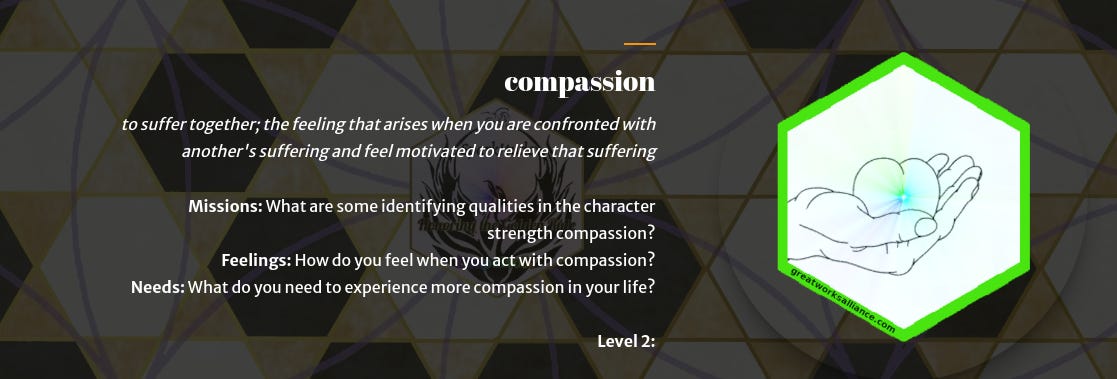
Compassion asks us to actually walk in another person's shoes, evaluate the pain, and walk with that person right out of the suffering.
Mission:
As you sit with this strength, keep in mind that these questions are not meant to make you feel alone or estranged from it. They are here to empower your true inner sparks to shine more strongly. If you experience a dissolution of a strength or virtue, that does not mean it is gone — only that it has not yet surfaced.
Sit with something soft and warming — a gentle herbal blend — and slowly read each one.
Identifying: What are some identifying qualities in the character strength of compassion?
Think of the people in your life who do not flinch when you are in pain and distress. Who do not rush to fix it, explain it, or minimize it — but simply hold space with you. What do you notice about how they are present with you? Is there a quality of stillness, of full attention, of being willing to be uncomfortable so you do not have to be alone in it? Where have you been that person for someone else — not because it was easy, but because something in you could not look away?
Feelings: How do you feel when you act with compassion?
Something profound happens in the body and mind when you genuinely enter another person's suffering with them — a tenderness, a weight, and underneath it something that feels like the truest version of yourself. It does not always feel good. Sometimes it feels like grief. Notice what it costs you and what it gives back. Notice also the difference between the compassion that depletes and the compassion that sustains — because that difference is important information.
Needs: What do you need to experience more compassion in your life?
Compassion requires something most environments do not provide — enough safety to be affected by others without being destroyed by them. Enough inner strength and fortitude to enter another’s pain without drowning in it. What would need to be true in your life for you to feel more able to take on some of the pain in others? And where do you need compassion extended toward yourself first, before you can offer it fully to anyone else?


The Shadow Side
Some of the most compassionate people also do not know how to release the pain once they have walked the path. Compassion without boundaries becomes self-erasure. The person who enters every suffering, carries every weight, and never steps back eventually has nothing left to give — and the people they were trying to help feel the collapse more than they ever felt the care.
Another shadow is the one the definition already names: the person who feels motivated to relieve suffering but acts on their own discomfort rather than the other person’s need. The suffering makes them uncomfortable, so they move to end it — not for the one who is hurting, but for themselves. The action looks like compassion. The motivation is relief from their own feelings.
The question the shadow asks is precise:
Am I opening myself up to this person’s suffering — or am I trying to make it stop so I do not have to feel it anymore?
True compassion stays long enough to understand what is actually needed before it moves to act.
The Strength’s Roots
Compassion wells up in our heart — where the recognition of another's suffering first lands, and where the motivation to relieve it is born.
A steady hand and mind are what allow you to hold that pain without being destroyed by it — the inner fortitude that makes true compassion sustainable rather than consuming.
The heart must be open enough to receive what another is carrying. The mind steady enough to know what is needed. The hand steady enough to stay.
On Compassion and Humanity
Compassion sits under the Character Virtue of Humanity alongside Communication. This placement is not incidental and is another undervalued strength not yet in use in the VIA infrastructure.
Communication builds the bridge. Compassion is what makes you willing to cross it — to enter another person’s experience fully enough to understand what they are actually saying beneath the words.
Together they are the full expression of Humanity in relationship. One finds the language. The other finds the courage to be present without retreating.
Inside the SparkITude deck, Compassion surfaces in the room not as sentiment but as steadiness. The person who carries it does not perform their care. The room simply feels less alone when they arrive.
Explore the virtues and strengths of SparkITude at Great Works Alliance.
If this strength is calling to you, the Resiliency Quest is waiting. It lives at a different address, but it is the same work.
In Service of Your Wholeness,
The Great Works Alliance Team
Lyra Star and Nate Cruz
The answers that live inside you are part of this work too. We invite you to share them — with us, with someone you trust, or simply with yourself.
May you find the ground within yourself steady enough to stand in the suffering of another — and may every act of true compassion remind you that you were never meant to carry it alone.


